Approach Trajectories & Splines
Physics-Bounded Curves, Arc-Length Parameterization & Swept Clearance
Standard Bezier curves evaluated at naive normalized time $t \in [0, 1]$ suffer from a fatal flaw: when a curve bends sharply, equal steps in $t$ cover vastly different physical distances. This causes flying creatures to accelerate violently through turns and decelerate unnaturally on straights.
PERCH solves this with Arc-Length Parameterized Hermite Splines backed by pre-computed Look-Up Tables (LUTs).
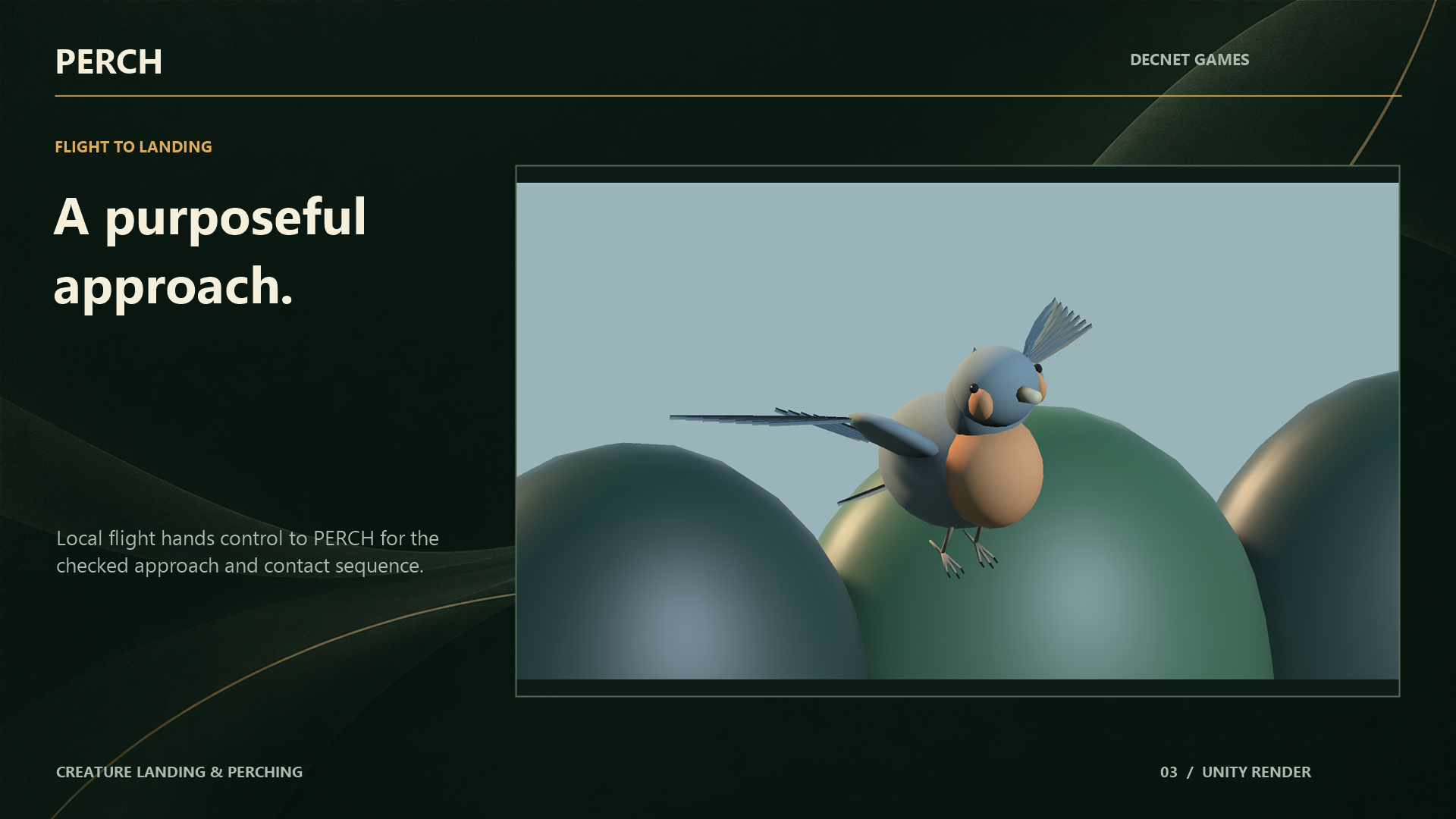
The Arc-Length LUT Hermite Spline Solver
To guarantee constant, controllable deceleration along physical profile limits:
- When a landing route is generated, PERCH computes a cubic Hermite spline connecting the creature’s current flight state $(\mathbf{P}0, \mathbf{V}_0)$ to the slot’s contact pose $(\mathbf{P}{\text{contact}}, \mathbf{N}_{\text{normal}})$.
- The curve is numerically integrated into a 32-sample Arc-Length Look-Up Table (LUT): \(s(t_i) = \int_{0}^{t_i} \|\mathbf{S}'(\tau)\| \, d\tau\)
- During runtime ticks, given the creature’s current distance traveled along the path $s$, the exact parametric coordinate $t$ is resolved via binary search and linear interpolation within the LUT: \(t = \text{LUT}^{-1}(s)\)
- This ensures that physical braking profiles (deceleration up to $8\text{ m/s}^2$) produce perfectly smooth velocities regardless of how sharply the trajectory curves.
+-----------------------------------------------------------------------------------+
| Parametric Spline S(t)  -->  Arc-Length LUT (32 Samples)  -->  Uniform Trajectory |
+-----------------------------------------------------------------------------------+
|  [HIGH CURVATURE]   === Dense Arc-Length Samples ===> Controlled Physical Speed   |
|  [LOW CURVATURE]    === Sparse Arc-Length Samples ==> Smooth Braking Profile      |
+-----------------------------------------------------------------------------------+
Flight Styles: ForwardGlide vs HoverDescent
PERCH provides two fundamentally different flight profiles depending on creature biology or mechanics:
| Metric | ForwardGlide (Birds, Winged Creatures) | HoverDescent (Drones, Hummingbirds, VTOL) |
|---|---|---|
| Minimum Airspeed | Strictly $> 0$ until touchdown. Cannot stop mid-air. | $0\text{ m/s}$. Can stop, hold position, and hover. |
| Approach Path | Sweeping aerodynamic arc aligning with perch axis. | Direct descent vector onto the landing patch. |
| Flare Dynamics | Pitches upward to convert kinetic energy into drag. | Level attitude or slight counter-thrust pitch. |
| Banking | Banks dynamically into turns ($\phi = f(\text{speed}, \text{curvature})$). | Yaw-in-place with independent tilt limits. |
| Touchdown Envelope | Shallow tangential angle of attack ($15^\circ - 35^\circ$). | Vertical or steep descent ($45^\circ - 90^\circ$). |

Aerodynamic Flare & Kinematic Limits
In nature, birds do not fly at full speed into a branch and stop instantly. They flare their wings, pitch their breast upward, and bleed velocity right at the contact threshold.
PERCH replicates this with profile-driven kinematic limits:
- Cruise Speed: Nominal roaming speed (default: $4.0\text{ m/s}$).
- Approach Speed: Speed entering the approach corridor (default: $2.0\text{ m/s}$).
- Touchdown Relative Speed: Speed at the moment of contact (strictly $\le 0.25\text{ m/s}$).
- Max Deceleration: Maximum allowable braking force (default: $8.0\text{ m/s}^2$).
- Max Turn Rate: Maximum angular yaw velocity (default: $120^\circ/\text{s}$).
If a prospective landing route requires a turn or deceleration that exceeds these limits, the candidate is discarded with RouteInfeasible before wasting CPU cycles on physics sweeps.
Swept Corridor Clearance Verification
Before an agent commits to an approach curve, the swept flight corridor must be proven clear of external obstacles:
[Start Envelope]   ======== Swept SphereCast Corridor ========   [Touchdown Funnel]
  (Agent Radius)   -------------------------------------------      (Slot Patch)
- Initial Overlap Check: A sphere check at the creature’s current position verifies that the agent is not already inside scene geometry. If obstructed by an external collider, it fails with
StartOverlapped. - Path Segment Sweeps: The spline is segmented (up to 32 segments) and evaluated using non-allocating sphere casts (
SphereCastNonAlloc). If an obstacle intersects the corridor, planning fails withApproachBlocked. - Touchdown Exemption: In the final arrival segment, the slot’s assigned Support Collider is granted an exclusive collision exemption so the perch itself is not registered as an obstacle.
- Departure Feasibility: In addition to the approach, PERCH verifies that an initial departure escape vector is clear before committing to touchdown.
[!TIP] All collision sweeps use statically preallocated hit arrays. If dense geometry saturates the buffer capacity, PERCH safely rejects the path with
QuerySaturatedrather than risking an unverified path passing through an obstacle.