Moving Platforms & Dynamic Perches
Landing on Rocking Ships, Swaying Branches & Moving Vehicles
Landing on a stationary surface is simple; landing on a boat rolling in choppy water, an airship flying through a storm, or a tree branch swaying in high wind is notoriously difficult. Most tools assume world-space static positions, leading to missed landings, feet clipping through decks, or physics explosions.
PERCH handles moving perches as first-class citizens through Kinematic Target Sampling and Relative Contact Coordinate Frames.
Kinematic Support Sampling
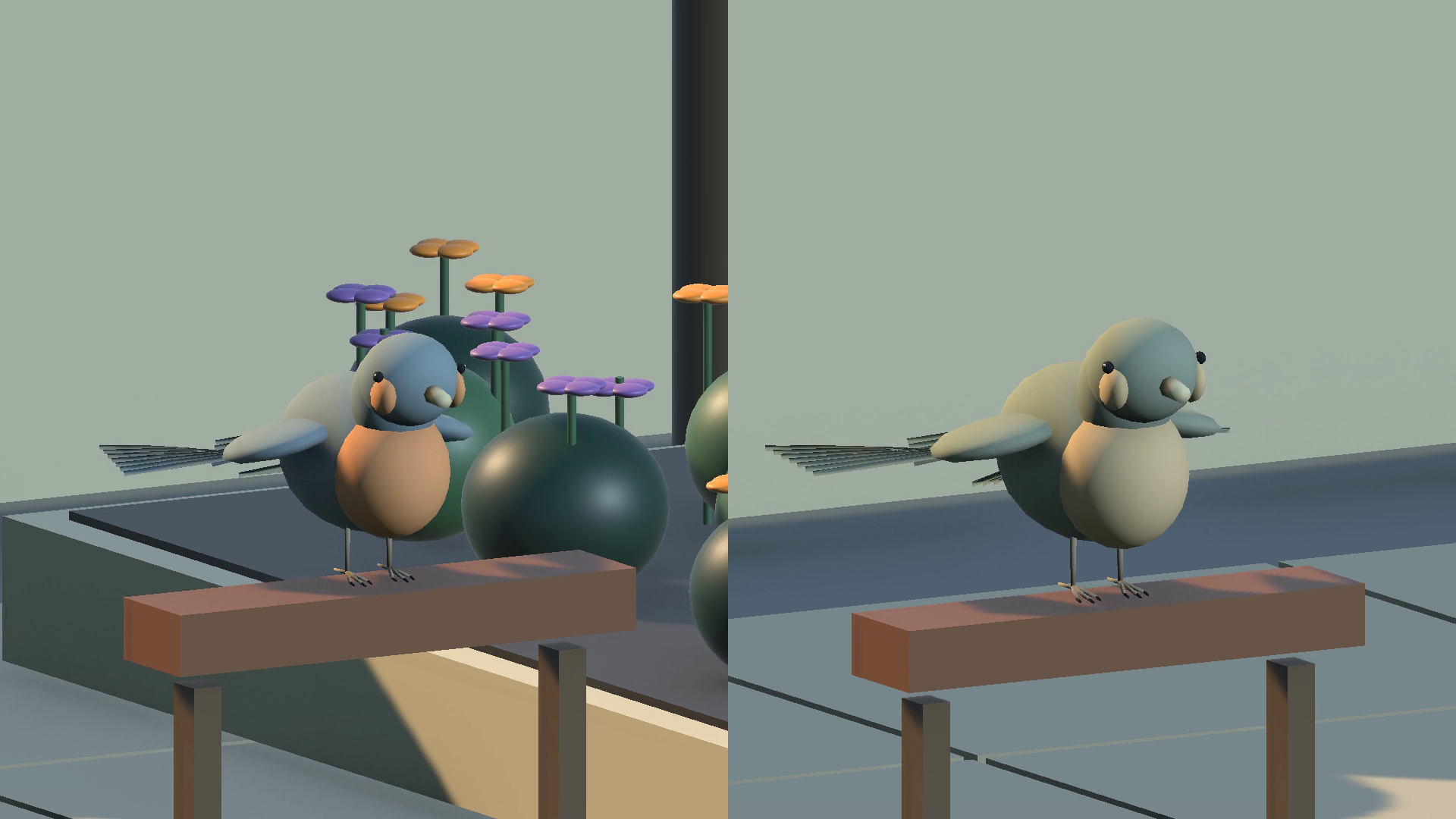
When a PerchSpot is parented to a moving transform, it tracks target kinematics across simulation ticks:
Platform Transform (Moving)
└── PerchSpot (Samples Delta P and Delta R per tick)
    └── PerchSlot (Relative Contact Coordinate Frame)
- Stationary Fast-Path: If the support transform has not moved between ticks,
PerchSpot.SampleKinematicsimmediately takes an identity fast-path, skipping quaternion inversions and cross-product math. - Velocity & Acceleration Estimation: When movement occurs, the spot continuously computes:
- Instantaneous linear velocity $\mathbf{V}_{\text{platform}}$
- Angular velocity $\mathbf{\omega}_{\text{platform}}$
- Linear acceleration $\mathbf{a}_{\text{platform}}$
- Trajectory Replanning: As the creature approaches, the trajectory solver re-evaluates the arrival spline relative to the projected touchdown position of the moving support.
Operating Limits & Teleport Protection
Creatures cannot land on a platform moving at Mach 1. PERCH enforces configurable physical boundaries in the PerchCreatureProfile:
| Parameter | Default Threshold | Behavior If Exceeded |
|---|---|---|
| Max Platform Linear Speed | $2.0\text{ m/s}$ | Trajectory rejected with TargetMotionExceeded. |
| Max Platform Angular Speed | $30^\circ/\text{s}$ | Approach aborted; agent recovers to free flight. |
| Max Platform Acceleration | $3.0\text{ m/s}^2$ | Approach aborted; prevents landing on jerking platforms. |
| Teleport Displacement Limit | $> 0.5\text{ m}$ in 1 tick | Flagged as TargetTeleported; immediate emergency abort. |
| Teleport Angular Limit | $> 30^\circ$ in 1 tick | Flagged as TargetTeleported; immediate emergency abort. |
If a platform suddenly teleports (such as a cinematic cutscene reposition or level streaming warp), PERCH detects the discontinuous delta and instantly commands approaching creatures into AbortRecovery, preventing visual artifacts.
Relative Contact Coordinate Frame
Once the creature reaches Touchdown, its position and rotation are anchored relative to the support transform:
- Sub-Millimeter Stability: Even on rapidly pitching ship decks, the creature’s feet remain locked to the surface without jitter or drifting.
- Non-Uniform Scale Protection: Moving supports must maintain uniform positive scale (
1, 1, 1). If a moving parent uses non-uniform or animated scale, PERCH emitsUnsupportedScaleto protect solver stability.
Departure Velocity Inheritance
When a bird departs from a moving vehicle, it does not launch from zero world velocity—it inherits the vehicle’s momentum.
During the TakingOff phase, the exit velocity returned to the IPerchFlightProvider combines the creature’s forward flap launch vector with the platform’s tangential velocity:
        ^ V_creature_launch (Upward & Forward Flap)
        |
        +-----> V_platform (Moving Ship Deck Velocity)
       /
      v Resulting V_exit smoothly handed to FlightProvider
This prevents the jarring visual pop where a bird appears to hit an invisible wall immediately upon leaving a moving boat or train.