Getting Started
Core Concepts, System Architecture & The 7-Phase Landing Lifecycle
PERCH is designed around a single guiding philosophy: predictable, physically bounded behavior under all runtime conditions. Rather than relying on fuzzy steering forces or unconstrained raycast snaps, PERCH coordinates flying creatures through a clear contract between spatial registries, atomic reservations, trajectory solvers, and animation drivers.
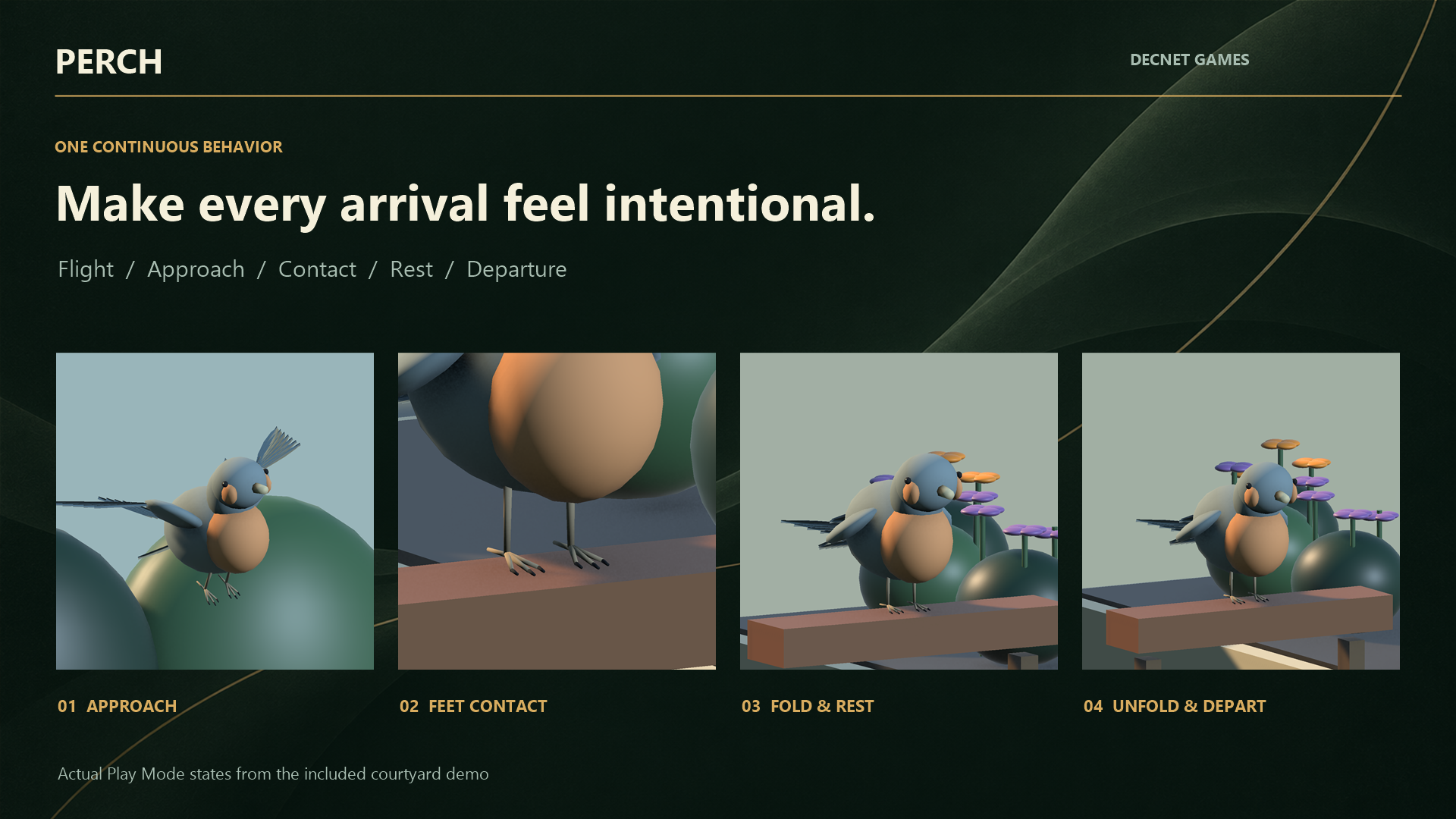
Core Components Overview
The PERCH runtime is partitioned into decoupled subsystems. Understanding how these components communicate is key to integrating PERCH into your game:
                                  +-------------------+
                                  |    PerchWorld     |
                                  | (Spatial Hash 3D) |
                                  |  (LeaseManager)   |
                                  +---------+---------+
                                            |
                         +------------------+------------------+
                         |                                     |
                         v                                     v
               +-------------------+                 +-------------------+
               |    PerchAgent     |                 |     PerchSpot     |
               | (State Machine)   |                 | (Authored Slots)  |
               +---------+---------+                 +---------+---------+
                         |                                     |
        +----------------+----------------+                    |
        |                |                |                    v
        v                v                v          +-------------------+
+---------------+ +---------------+ +---------------+|     PerchSlot     |
| CreatureProfile| |  PerchMotor  | | FlightProvider|| (Contact Frame)   |
+---------------+ +---------------+ +---------------+ +-------------------+
1. PerchWorld
The master coordinator for a given physical environment.
- Owns the 3D spatial hash index (
SpatialHash3D) storing all active perches. - Runs the atomic
LeaseManagerto prevent simultaneous slot claims. - Maintains the simulation clock (
SimulationClock), enabling pause/resume, time scaling, and deterministic integration tests. - Implements the per-tick physics and candidate scan scheduler.
[!NOTE] You can run multiple independent
PerchWorldinstances in the same Unity project (e.g., in multi-scene or additive scene configurations). Agents and spots assigned to different worlds will never interact or exchange leases.
2. PerchSpot and PerchSlot
PerchSpot: A MonoBehaviour attached to scene geometry (such as a tree branch, telephone wire, stone fence, or ship railing). It tracks whether the support is stationary or moving and manages a collection of slots.PerchSlot: A lightweight serializable struct representing an individual landing position. Each slot defines:- Local contact position and rotation (where Y is the surface normal and Z is the creature’s facing forward direction).
- Associated physical support collider.
- Contact mode (
Point,Line, orPatch). - Reserved exclusion footprint radius (to prevent wings overlapping neighbors).
- Accepted creature styles and tags.
3. PerchAgent
The brain attached to the creature root.
- Manages the 10-state deterministic finite state machine (FSM).
- Processes landing commands (
RequestLanding,RequestSlot,Depart,CancelLanding). - Governs motor ownership handover between free roaming and approach curves.
- Emits strongly typed events (
OnStateChanged,OnLanded,OnDeparted,OnLandingFailed).
4. PerchCreatureProfile
An immutable ScriptableObject defining physical and aerodynamic capabilities:
- Physical dimensions: body length, body radius, contact span, clearance margins.
- Flight kinematics: cruise speed, approach speed, touchdown speed tolerance, max acceleration, max deceleration, turn rate.
- Moving perch limits: maximum platform linear speed, angular speed, and acceleration.
- Dwell and retry timings: min/max perch dwell duration, retry cooldowns, recent-slot penalties.
5. IPerchFlightProvider & IPerchMotor
IPerchFlightProvider: Drives the agent during free flight roaming. PERCH ships withPerchWaypointFlightProvider, but you can plug in any custom steering, boids, or navigation AI.IPerchMotor: The single component responsible for writing root transform movements. Built-in implementations includeTransformMotorandKinematicRigidbodyMotor.
The 7-Phase Creature Landing Lifecycle
Every perch-and-depart cycle executes through seven deterministic stages:
[1. Free Flight] ──> [2. Selection] ──> [3. Planning] ──> [4. Approach]
                                                               │
[7. Takeoff]     <── [6. Dwell & Fold] <── [5. Touchdown] <────┘
Phase 1: Free Flight Roaming (FreeFlight)
The creature moves freely through the environment under the control of its IPerchFlightProvider. During this phase, PERCH’s motor is inactive (MotionOwner.ExternalProvider). The agent enforces a configurable minimum flight duration before auto-landing policy triggers.
Phase 2: Candidate Selection (Selecting)
When an automatic decision interval elapses (or an explicit API call occurs), the agent queries the PerchWorld spatial hash:
- Hard Filtering: Discards spots with mismatched creature styles, tags, or dimension limits.
- Coarse Distance Culling: Immediately rejects spots beyond the 50-meter operating envelope.
- Suitability Scoring: Evaluates reachability, distance, approach alignment, and recent-use penalties.
- Tie-Breaking: Uses seeded, deterministic evaluation to select the best candidate.
Phase 3: Trajectory Planning & Lease Reservation (Planning)
Before moving toward the spot, PERCH guarantees safety:
- Atomic Claim: The
LeaseManagerchecks whether the slot and its neighboring footprint are free. If so, a lease token is granted with a monotonic request ID. - Hermite Spline Generation: An approach spline is calculated using arc-length look-up tables.
- Swept Clearance Check: SphereCast sweeps verify that external obstacles do not obstruct the approach corridor or the initial departure path.
- If any check fails, the lease is released cleanly and the agent returns to
FreeFlighton cooldown.
Phase 4: Swept Approach & Physical Deceleration (Approaching)
- PERCH acquires motor control (
MotionOwner.PerchMotor). - The creature follows the arc-length parameterization, decelerating smoothly from cruise speed to approach speed.
- Periodic heartbeats maintain the lease.
- If a dynamic obstacle moves into the swept corridor or the target platform accelerates beyond safe limits, the agent initiates an
AbortRecovery.
Phase 5: Contact Solve, Touchdown & Stance Lock (Touchdown)
- As the creature crosses the final arrival boundary, the solver aligns the root to the slot’s contact frame.
- The optional
PerchTwoBoneIkSolveror leg stance markers engage, pinning talons/feet firmly to the collider geometry. - Relative contact speed drops below the profile’s touchdown tolerance (default $\le 0.25\text{ m/s}$).
- The slot transitions from
ReservedtoOccupied.
Phase 6: Perched Dwell & Wing Fold Hold (Perched)
- The creature holds its stance on the perch.
- The animation system triggers wing folding (via Mecanim crossfades, Playables stance holds, or procedural harmonic damping).
- Subtle breathing and balance bobbing can be applied while feet remain anchored.
- If the perch is on a moving platform (e.g., a boat railing or swinging branch), the agent tracks the platform’s local coordinate frame.
Phase 7: Safe Takeoff & Momentum Handover (TakingOff)
- When the dwell timer expires, or upon receiving a manual
Depart()or panic threat wave: - Departure sweeps verify that the takeoff corridor is free of obstacles.
- Wings unfold and flapping initiates before root translation begins.
- The agent moves forward/upward, holding its exclusion footprint until the body completely clears the perch area.
- Once clear, the slot is released back to
Free, and motion control is cleanly handed back toIPerchFlightProviderwith inherited departure velocity.
Next Steps
- Ready to install? Head to Installation & Requirements.
- Want your first bird flying in 5 minutes? Check out the Quick Start Guide.
- Deep dive into features? Explore Core Features.