Coverage Honesty
The most dangerous test result is the one that never ran
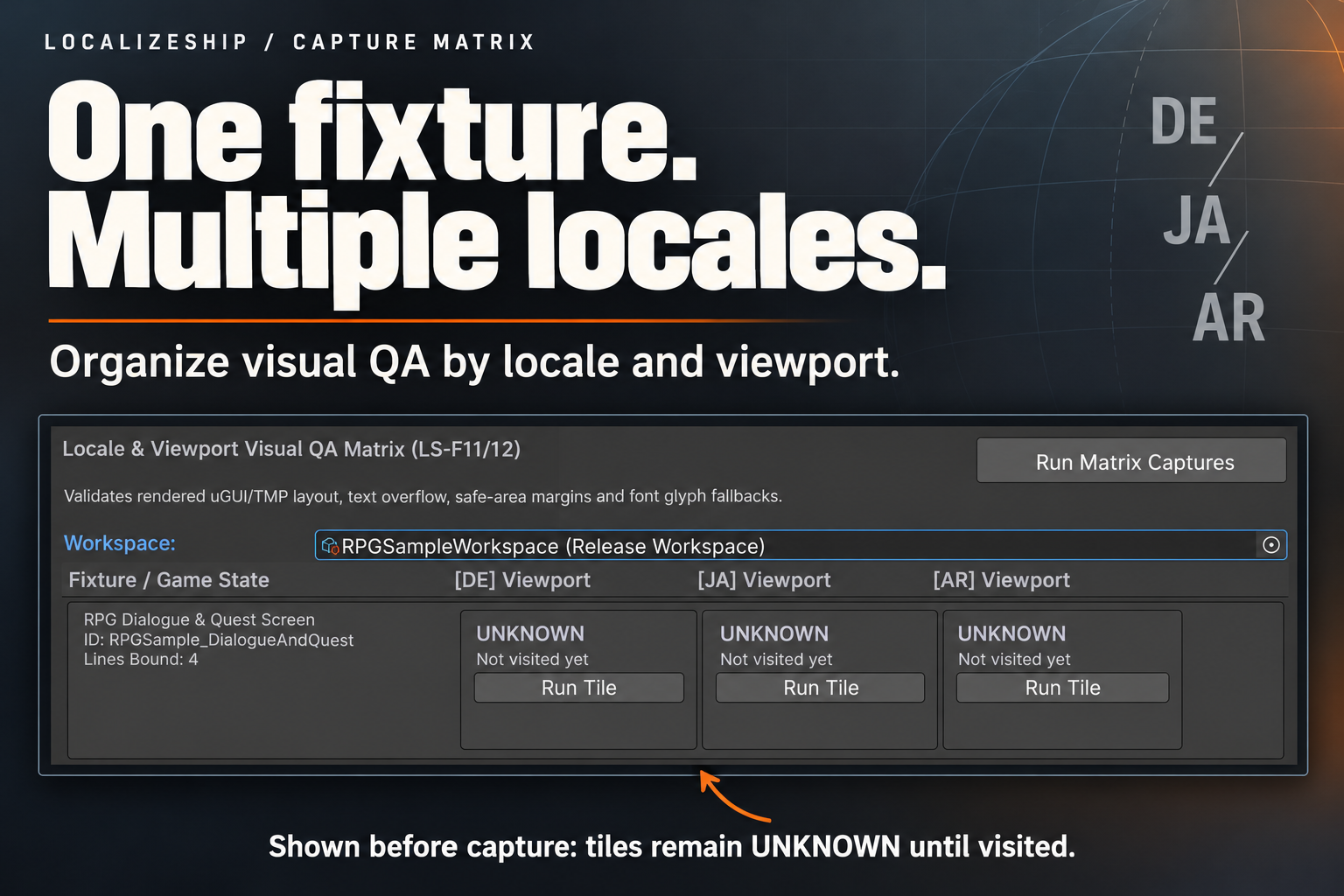
A release dashboard that shows 100% green because nothing was checked is worse than no dashboard. LocalizeShip treats not visited as a first-class state and refuses to call it a pass.
The four coverage states
public enum FixtureCoverageStatus
{
    Unknown,
    Registered,
    Visited,
    Failed
}
| State | Meaning | Gate treatment |
|---|---|---|
Unknown | A capture fixture exists in the workspace but has no result tile | Counted as unvisited |
Registered | A tile is known but has not been visited | Counted as unvisited |
Visited | CaptureRunner.ExecuteFixture produced a tile | Inspected for findings |
Failed | The tile was marked failed | Not counted as unvisited in the current gate |
Failedis not treated as a blocker by the current gate’s unvisited count. If a fixture failed to capture, add a finding or handle the state in your own gate extension. Do not assumeFailedautomatically fails a release.
A fresh CaptureTileResult starts as Unknown. CaptureRunner sets Coverage = Visited at the start of a run.
Editor approximation versus player capture
The model carries a label:
public bool IsPlayerCapture; // true = Player bridge, false = Editor approximation
The Capture Matrix window calls the runner with isPlayerMode: false, and the UI prints Editor Approximation. There is no player bridge in 1.0.0, and the shipped code does not produce a true value for that field.
What that means in practice:
- Layout is measured against the current Editor canvas state.
PrepareFixtureForLocaleswitches the fixture’s locale through any childSetLocale(string)method.Canvas.ForceUpdateCanvases()is called before measurement.- The result is an Editor-side layout evaluation, not proof of what a device renders.
LocalizeShip does not claim player-capture verification. The product deliberately does not certify device rendering, platform font fallback, or runtime aspect-ratio behaviour in 1.0.0. Treat the matrix as a fast Editor-side early-warning system, not a substitute for a device smoke test.
What the screenshot file is — and is not
CaptureRunner writes a PNG named:
{FixtureId}_{locale}_{width}x{height}.png
The current implementation fills a texture with a background colour (slightly different for Arabic) and writes it. It does not read the game camera, does not call ScreenCapture, and does not composite the UI.
So the screenshot is a file artifact that records that a capture ran at a resolution. It is not visual evidence of the rendered screen. Findings come from rectangle measurement and font glyph queries, not from image analysis.
This is exactly the kind of thing a documentation site should say out loud. If you need rendered frames, extend the runner to capture the camera/render texture and keep the same coverage labels.
Resolution and viewport honesty
The runner accepts a Vector2Int resolution and stores it on the tile. The Capture Matrix window always passes 1920 × 1080 for a tile run. It does not resize the game view, the canvas, or the screen before measuring.
Therefore:
- “Locale × viewport” in 1.0.0 means locale × recorded resolution label.
- There is no device-preset enumerator and no automatic resize loop.
- If you need true multi-viewport coverage, drive the runner from your own code after resizing the target canvas, and store the resulting tile per resolution.
The product concept describes a fuller viewport matrix. The current implementation is narrower, and the documentation does not pretend otherwise.
Unknown is not empty
An empty findings list on a Visited tile means “the rules found nothing on the elements that were measured.” It does not mean the screen is correct. Concretely, the rules cannot see:
- text that is visually clipped by a mask without a rect overflow;
- overlap between two elements (
LayoutCollisionis defined but no rule emits it); - clipping that does not exceed the container rect;
- untranslated content that renders fine;
- linguistic quality, grammar, tone or RTL correctness.
A tile with zero findings is evidence that four geometric checks passed on the bound elements. That is all.
The honesty contract
| Claim | Status |
|---|---|
| “We measured overflow against the container rect” | Supported |
| “We detected missing glyphs in the font asset” | Supported |
| “We checked safe-area bounds” | Supported |
| “We checked minimum touch-target size” | Supported |
| “We evaluated every registered fixture” | Only if Coverage == Visited for each tile |
| “We captured the actual rendered player screen” | Not claimed |
| “The layout is correct on device” | Not claimed |
| “The Arabic/RTL text is linguistically correct” | Not claimed |
| “Every dynamic string was visited” | Not claimed; dynamic paths need explicit fixtures |
How to use coverage honestly in a release review
- Register fixtures for every screen that contains localized text. A missing fixture is worse than an unknown tile because it does not even appear as a gap.
- Run every tile for every target locale. Do not sample.
- Read the gate’s “unvisited” count before reading the findings count. Zero findings with three unvisited tiles is not a pass.
- Label the evidence. If you attach an Editor run to a release ticket, say “Editor approximation, 1920×1080, [date]”.
- Keep the device test separate. A green matrix does not replace a build smoke test.