Custom Adapters
Bring your own string database
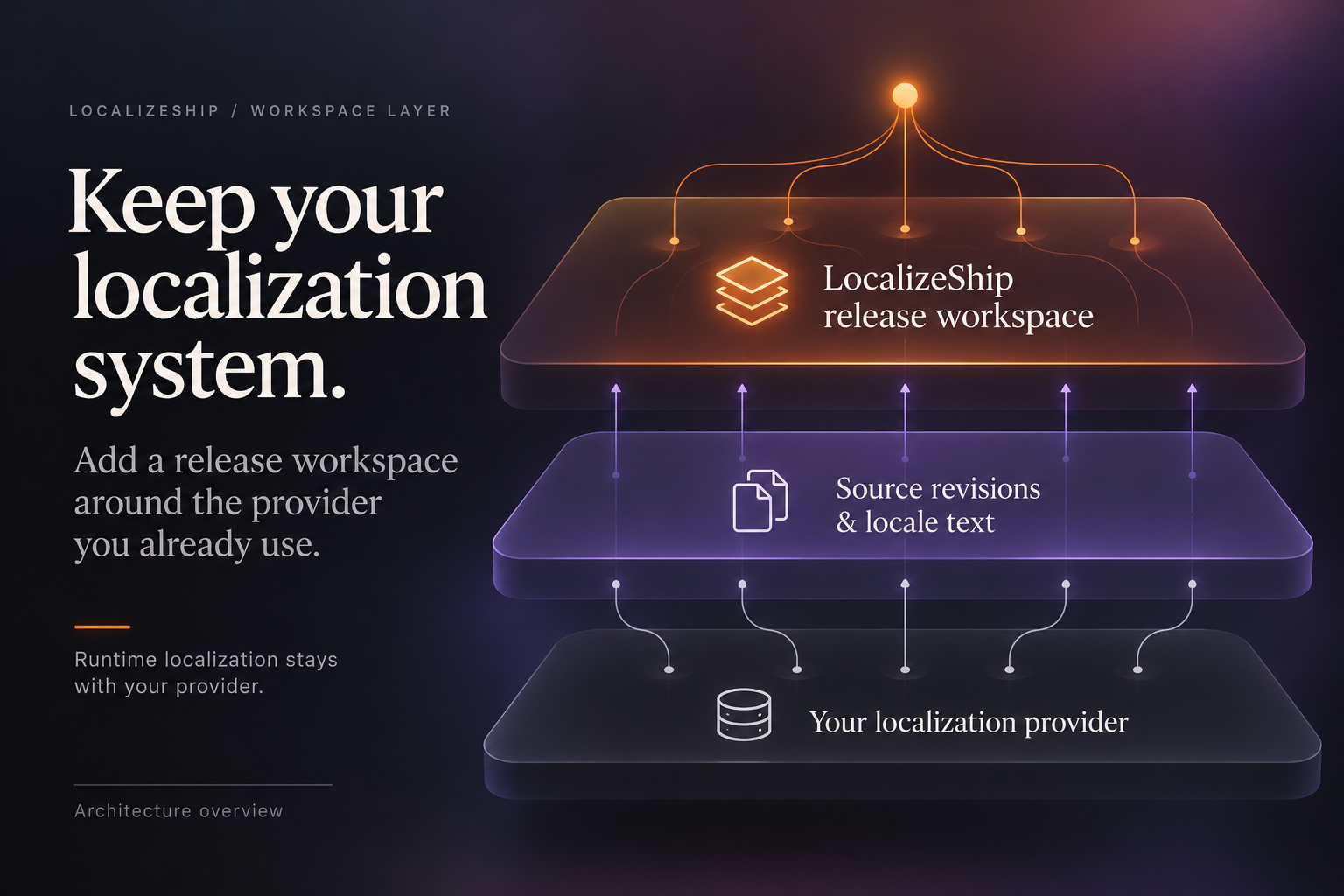
If your strings live in JSON, XML, a database or an in-house editor, you can implement ILocalizationProvider and feed the same workspace, handoff and gate pipeline.
The capture shows the optional I2 Localization and Dialogue System adapters absent; it is not licensed-install verification.
The interface, again
public interface ILocalizationProvider
{
    string ProviderId { get; }
    string DisplayName { get; }
    bool IsInstalled { get; }
    string VersionString { get; }

    List<string> GetAvailableCollectionNames();
    List<SourceRevision> ReadCollection(
        string collectionName, string sourceLocale, NormalizationPolicy policy);
    string GetTranslation(
        string collectionName, StableEntryId entryId, LocaleId locale);
    void WriteTranslation(
        string collectionName, StableEntryId entryId, LocaleId locale, string newText);
}
The interface lives in Decnet.LocalizeShip.Adapters. Implement it in an editor assembly, because the pipeline writes assets and marks them dirty.
A JSON adapter, end to end
Assume files like:
{
  "locale": "en",
  "entries": [
    {
      "key": "ui.play_button",
      "text": "Play",
      "speaker": "System",
      "context": "Main menu"
    }
  ]
}
The adapter
using System.Collections.Generic;
using System.IO;
using Decnet.LocalizeShip.Adapters;
using Decnet.LocalizeShip.Core.Models;
using UnityEngine;

public class JsonProvider : ILocalizationProvider
{
    private readonly string _root;

    public JsonProvider(string root) { _root = root; }

    public string ProviderId => "JsonFiles";
    public string DisplayName => "JSON String Files";
    public bool IsInstalled => Directory.Exists(_root);
    public string VersionString => "1";

    public List<string> GetAvailableCollectionNames()
    {
        var list = new List<string>();
        if (!Directory.Exists(_root)) return list;
        foreach (var f in Directory.GetFiles(_root, "*.json"))
            list.Add(Path.GetFileNameWithoutExtension(f));
        return list;
    }

    private string PathFor(string collection, string locale) =>
        Path.Combine(_root, $"{collection}.{locale}.json");

    public List<SourceRevision> ReadCollection(
        string collection, string sourceLocale, NormalizationPolicy policy)
    {
        var results = new List<SourceRevision>();
        string path = PathFor(collection, sourceLocale);
        if (!File.Exists(path)) return results;

        var file = JsonUtility.FromJson<JsonTable>(File.ReadAllText(path));
        foreach (var e in file.entries)
        {
            results.Add(new SourceRevision(
                new StableEntryId(e.key), e.text, e.speaker, e.context, policy));
        }
        return results;
    }

    public string GetTranslation(
        string collection, StableEntryId entryId, LocaleId locale)
    {
        string path = PathFor(collection, locale.Code);
        if (!File.Exists(path)) return null;
        var file = JsonUtility.FromJson<JsonTable>(File.ReadAllText(path));
        foreach (var e in file.entries)
            if (e.key == entryId.Value) return e.text;
        return null;
    }

    public void WriteTranslation(
        string collection, StableEntryId entryId, LocaleId locale, string newText)
    {
        string path = PathFor(collection, locale.Code);
        JsonTable file = File.Exists(path)
            ? JsonUtility.FromJson<JsonTable>(File.ReadAllText(path))
            : new JsonTable { locale = locale.Code, entries = new List<JsonEntry>() };

        var found = file.entries.Find(e => e.key == entryId.Value);
        if (found != null) found.text = newText;
        else file.entries.Add(new JsonEntry { key = entryId.Value, text = newText });

        File.WriteAllText(path, JsonUtility.ToJson(file, true));
    }

    [System.Serializable] private class JsonTable
    {
        public string locale;
        public List<JsonEntry> entries = new List<JsonEntry>();
    }

    [System.Serializable] private class JsonEntry
    {
        public string key;
        public string text;
        public string speaker;
        public string context;
    }
}
Register it
Discovery is a code list, not a plugin scan:
public static class MyProviderRegistration
{
    public static List<ProviderInfo> DiscoverAll()
    {
        var list = ProviderDiscoveryService.DiscoverProviders();
        var json = new JsonProvider("Assets/Localization");
        list.Add(new ProviderInfo
        {
            ProviderId = json.ProviderId,
            DisplayName = json.DisplayName,
            IsInstalled = json.IsInstalled,
            Version = json.VersionString,
            Collections = json.GetAvailableCollectionNames()
        });
        return list;
    }
}
To change Guided Setup, patch your own copy of its provider loop (or your project’s fork). The shipped window calls ProviderDiscoveryService.DiscoverProviders() directly.
Ingest revisions safely
Do not blindly add duplicates. Use the tracker so changed source lines mark translations stale:
var tracker = new RevisionTracker();
var provider = new JsonProvider("Assets/Localization");

foreach (var rev in provider.ReadCollection("UI", "en", workspace.Normalization))
{
    var current = workspace.GetSourceRevision(rev.EntryId);
    if (current == null)
        workspace.SourceRevisions.Add(rev);
    else if (current.RevisionHash != rev.RevisionHash)
        tracker.ProcessSourceEntry(
            workspace, rev.EntryId, rev.RawText, rev.Speaker, rev.ContextDescription);
}
ProcessSourceEntry updates the existing revision, invalidates approvals, and rechecks bound voice entries. Review the Revision Graph before wiring this into a build step.
Design rules
- Stable keys. Never use array indices or auto-increment IDs that can change.
- Deterministic reading. The same file should produce the same hashes. Avoid timestamps in context fields.
- No hidden normalization. Let the workspace’s
NormalizationPolicydo it; do not trim twice with different rules. - Fail visibly on write. If a collection or locale is missing, throw rather than silently doing nothing.
- No approval logic in the adapter. The adapter moves text; review state belongs to the workspace.
- No network in the adapter. Keep ingestion local and auditable.
Testing your adapter
- Read the same collection twice and compare hashes — they must match.
- Rename a key and confirm the workspace sees a new entry, not a silent overwrite.
- Change a source line and confirm existing approvals become
Stale. - Write a translation and confirm the file is valid JSON/XML and the entry is found on re-read.
- Run the read path on a missing collection and confirm it fails or returns empty deliberately.
See Testing & Verification for the package’s own acceptance coverage.